JH

Every week somebody sends us a plot size and a budget and asks what to put on it. There is no single answer. But after enough parks you start to notice that the ones filling up on a Saturday afternoon all have roughly the same eight things inside them.
Here they are, in the order we would spend the money if the park were ours. That is not always the order that earns a supplier the biggest commission, which is usually a shorter and more expensive list.
Sort out power and access before anything else
Two numbers decide everything downstream of them.
- Connected power. A park with eight mid-size rides typically draws 150 to 300 kW. That is not a domestic supply. Start the transformer conversation with your utility before you order the first ride, not the month it arrives.
- Access. How does a 12 m trailer reach your site? Plenty of builds lose a month because the last 300 m of road cannot take a low-loader.
If those two are wrong, the ride list stops mattering.
1. Carousel, the cheapest landmark you can buy
A carousel is not the biggest earner in a park. It is the cheapest way to make a piece of land look like an amusement park. Guests decide what kind of place you are within about thirty seconds of walking in, and a lit carousel does that job better than anything else at the price.
Two sizes cover most of what we ship: a 10 m, 44-seat carousel and an 11.5 m, 48-seat model. The 10 m double-deck 50 and 52 seat models go mostly to shopping malls and indoor family centres, where the ride has to read from two floors away.
The real reason it sits first is the height rule. A two-year-old can ride. A grandparent can ride. Nobody has to be talked into it. On a Saturday that is worth more than a slightly higher hourly capacity on paper.
Watch out for
- Seat count. A 10 m carousel describes the platform, not the capacity. We have seen quotations where the buyer assumed 44 seats and got 24. Put the number in writing.
- Canopy weight if the ride goes indoors. A double-deck unit hung over a mall atrium needs the building designed for it, not reinforced afterwards.
- The fiberglass animals are the part that ages first. Ask which gelcoat and which UV protection is specified, or expect them to look tired after two summers.
2. Ferris wheel, a billboard you can charge admission to
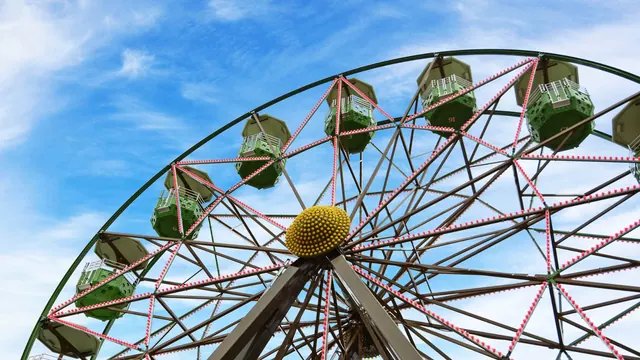
A ferris wheel is a marketing asset that happens to be a ride. If your site faces a road, a lit wheel at night outperforms any sign you can buy, and the photos end up on other people's feeds for free.
The working range for a park is 16 m to 25 m. Our 20 m ferris wheel sits right in the middle of that range, which is where most of our exports are. Below that you are in kiddie-wheel territory for malls and indoor atriums. Above 25 m the numbers stop moving in a straight line.
One thing operators underestimate: price does not scale with height. It scales faster. A 40 m wheel is not twice a 20 m wheel. It is a different foundation, a different shipping plan and a different installation crew.
Watch out for
- Cabins drive both price and comfort. Open gondolas cost less. Enclosed cabins with air conditioning cost more but let you run in poor weather and charge a premium for it.
- Ask in writing what happens during a power cut. There should be a defined emergency lowering procedure or a back-up drive.
- Get the soil report before you fix the position. Re-levelling ground under a tall wheel later is not a cheap correction.
3. Bumper cars: look at the arena before you look at the cars
If any ride gets a second queue in the same afternoon, it is this one. Bumper cars are interactive, competitive and understood in five seconds, so they keep earning long after the novelty rides have been tried once.
نُصنّع 19 bumper car models, from single-seat kids' cars up to heavy-duty multi-seat cars. The car is the easy decision. The arena is where projects go wrong.
| Arena item | Why it decides your project |
|---|---|
| Power system | A ceiling grid works well in a clean indoor hall. A floor grid suits outdoor sites, but the floor has to be built to a specification with the pick-up strips installed during the pour, not afterwards. |
| Ceiling height | A ceiling grid needs a structure above the arena to carry it. Design it into the building. Retrofitting a grid into a finished hall is expensive and sometimes impossible. |
| Hall shape | Square arenas use space better than long thin ones. A narrow hall ends up with a corner nobody ever drives into. |
| تركيبة الأسطول | Adult cars plus a few kids' cars usually outearn one uniform fleet, because a parent can ride with a small child instead of waiting outside. |
Floor area per car is the number people guess worst. As a planning guide rather than a rule, allow roughly 8 to 12 sqm of arena per car. Pack them in tighter and the arena turns into a traffic jam where nobody can build up speed, and that is also when damage claims start climbing.
4. Flying chairs, the best value per square metre
This is the one we recommend most often to operators who have spent most of the budget and still have an empty patch in the middle of the park. Flying chairs look like a major ride, need a modest footprint, and are gentle enough that almost anyone will board.
12 and 16 seat units are the standard export sizes. A 16-seat flying chair fits inside roughly a 12 m circle including the safety fence. Most people expect it to need more room than that.
Guests read it as a thrill ride. You get a family ride. On a mid-size plot that combination is hard to beat.
Watch out for
- Chain and hook inspection is a real, repeating maintenance line. Ask what the recommended interval is and whether the parts are standard sizes you can source locally.
- Siting. If you run a ferris wheel too, keep the two rides off the same sightline or they compete for attention instead of reinforcing each other.
5. Trackless train, the ride that keeps people in the park
Not exciting, quietly useful. A train gives older visitors and small children a way to move around a large site, and it gives you a moving billboard inside your own park.
Trackless models are what most parks buy now, from 27 seats up to 72; the 42-seat trackless train is a typical mid-size choice. No rail to lay, so it runs on paths you already have and can be re-routed when you expand.
It fixes two problems people do not plan for. It shortens the walk from the gate to the far end of the site, and it runs a loop past the food and drink outlets. Some operators earn more from that loop than from the ride ticket.
Watch out for
- Electric or diesel. Electric trains are quieter and cleaner, but plan the charging point and size the battery for a full day with a loaded train.
- Turning circle. Send us your path layout before ordering. The train has to physically follow it, including the corner at the entrance gate.
6. One ride that makes teenagers nervous
Somewhere in the park you need something with a bit of fear in it. Without that, the teenage group leaves by mid afternoon and takes its spending with it.
The usual answers are a swing pendulum or a pirate ship. We build 22 pendulum models, from a 12-seat mini up to 21 m and 23-seat giants with top drive, plus 7 pirate ships. If the space is tight and the budget is fixed, the ship is usually the smarter purchase: less steel, smaller foundation, and it still delivers the stomach drop.
Do not buy the tallest machine you can afford. Buy the tallest one your site, your power supply and your maintenance team can actually support. We have watched a 21 m pendulum sit idle for a season because the operator could not get engineering sign-off for the foundation it needed.
Watch out for
- Check what your local inspection authority requires before you order. Height and speed rules differ by country, and the ride has to be built to the right standard from the start rather than modified afterwards.
- Foundation and anchor drawings are not optional extras. Ask for them with the quotation, not after the deposit.
7. Go-karts, the highest ticket price on site
Karts earn differently from everything else on this list. Guests come back, they pay more per session, they stay longer, and a decent track starts selling season passes on its own.
The first decision is petrol or electric. Petrol karts, typically 200cc and 270cc single-cylinder air-cooled, cost less to buy and are simpler to run in hot climates, but they are loud and you need fuel handling plus ventilation. Electric karts are quieter and cleaner, and the better choice indoors or on mixed-use sites, but you pay for the fleet and the charging infrastructure together.
Our range runs from kids' single-seat karts up to an adult 270cc model and two-seat versions, using a #428 high-speed chain drive. The exact engine, frame and speed limit for each model are published on the product pages, because this is one category where vague specs cost people money.
Track layout matters more than the vehicles. A boring circuit loses customers no matter how good the karts are, so ask for a layout review with your quotation.
8. Kids' powered rides, where the family budget actually goes
Self-control planes, frog jumps, teacups, mini trains. Bought one at a time these look like small purchases. Together they are the reason a family stays three hours instead of forty minutes, and the reason the food and drink sales work at all.
نُصنّع 17 self-control plane designs, teacups from 6 m to 10 m, and a range of jump and spin rides. None of them is a headline attraction. All of them are busy all day.
One practical note: cluster them. A small-kids zone next to the seating and the cafe keeps parents in one place and makes supervision easier, and that is what actually decides whether the family comes back next month.
If the plot is small, buy in this order
Three cases we see often enough to write down.
| Situation | Buy first | Why |
|---|---|---|
| Under 1,500 sqm, indoor or mixed use | Carousel, kids' powered zone, teacups | Build the family base first. Bumper cars and karts need more room than most people expect. |
| 2,000 to 5,000 sqm, outdoor family park | Carousel, flying chairs, trackless train, bumper cars | Enough variety to fill a Saturday without the maintenance load of a big thrill ride. |
| 5,000 sqm plus, or an existing park adding rides | Ferris wheel, pendulum or ship, go-kart track, plus the family base | The landmark and the teen anchor start earning here. Karts carry the ticket price. |
ما كنا لنشتريه أولًا
A 40 m coaster or a tall drop tower are excellent rides. They are also among the worst first purchases for a new park, because the engineering, foundation, inspection and installation overhead lands on you before there is any revenue to pay for it. Get the family base earning, then add height.
The second thing we would not buy first is a fleet of anything. Buy one or two, watch what your guests actually queue for, then expand the winner. We sell rides for a living and we would still rather you did it that way.
Send us your plot size, the power you have available and roughly who your visitors are. We will come back with a layout sketch and a model list with factory-direct pricing. English-speaking engineers, usually within 12 hours.